BLOG
Hijab Headshots for Medical School and Residency
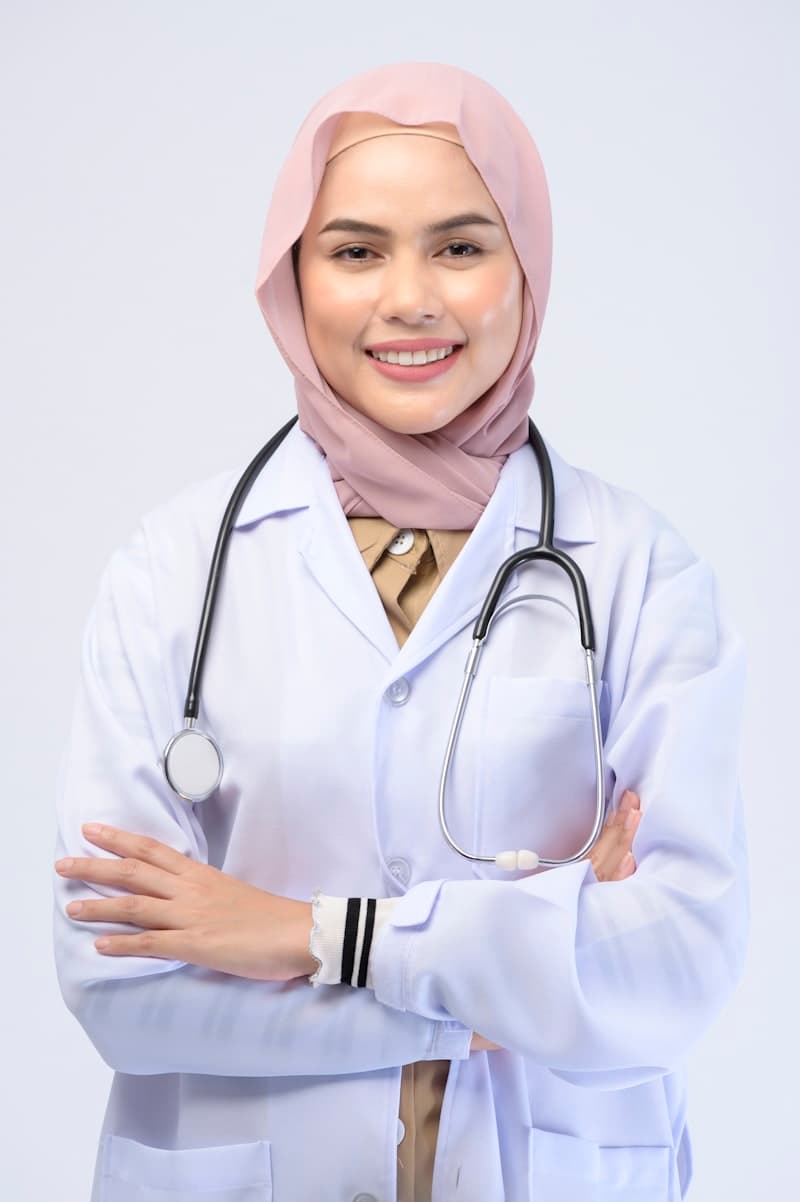
Medical school applications, residency programs through ERAS, hospital badges, and Zocdoc profiles all need your headshot. For hijab-wearing medical students and residents, there are extra considerations that standard headshot guides never cover. This is the complete guide to getting a hijab headshot that works for every stage of your medical career, from application to attending.
ERAS application photo requirements
The Electronic Residency Application Service has specific technical requirements for your headshot. Getting these wrong means your photo may be rejected or display poorly on program directors' screens. Here are the actual specs from the ERAS guidelines:
- -Dimensions: 2.5 x 3.5 inches
- -File size: 100 to 500 KB
- -Resolution: 150 dpi minimum
- -Format: JPEG
- -Color photo with a light or white background
- -Frontal view, head and shoulders only
- -Face centered with a small margin above your head
- -No requirement to remove head coverings -- your hijab is fully acceptable
That last point is worth emphasizing. ERAS does not ask you to remove your hijab, and no ACGME-accredited program can reject your application photo because of a religious head covering. The guidelines simply ask for a professional, clearly lit photo where your face is visible and recognizable.
When uploading, make sure the file is saved as a JPEG (not PNG) and falls within the 100 to 500 KB range. Photos from AI headshot generators and professional studios are typically well above the minimum resolution, so file size is the spec most applicants trip on. If your file is too large, resize it before uploading rather than compressing quality.
White coat photos: the hijab challenge
The classic medical headshot features a white coat on a white or light background. This creates a specific contrast problem if your hijab is also light-colored. When everything in the frame is white or cream, your face loses definition, and the image looks washed out at small display sizes like ERAS thumbnails and badge photos.
The solution is simple: a dark or navy hijab provides contrast against the white coat and light background. This creates a clear visual frame around your face, which is exactly what you want. Navy is the most popular choice among medical professionals for this reason. It reads as conservative and professional while solving the contrast issue completely.
If your preferred hijab color is white or cream and you do not want to change it for the photo, the alternative is to ask for a light gray or soft blue background instead of pure white. This gives enough separation between your hijab and the background without looking out of place in a medical context. Check out our guide to hijab colors for headshots for more detailed color pairing advice.
Hospital badge and ID photos
Hospital badge photos are a different beast from application headshots. They are typically a 2 x 2 inch square crop, often taken on-site during orientation with a point-and-shoot camera against a pull-down backdrop. The quality is usually mediocre at best.
For your badge photo, keep your hijab neat and consistent with how you wear it daily. You will see this photo every single day for years, and patients will see it too. If the badge photo is taken on the spot, there is not much you can control beyond your own styling. But if your hospital gives you the option to bring your own photo, use a professional headshot. The difference in quality is immediately noticeable.
Some hospitals require specific background colors for badge photos, typically plain blue or white. Check the requirements before your orientation day so you can either prepare accordingly or bring a suitable photo if they allow it. A solid-color hijab reads best at badge size, where patterns get lost and busy fabrics can make the small photo look cluttered.
What to wear for medical headshots
Medical headshots have a narrower range of acceptable styles than corporate photos. Here is a straightforward checklist:
- ✓Navy or charcoal hijab -- contrasts well with a white coat and light backgrounds
- ✓White coat if your program has provided one
- ✓Professional blouse or shirt underneath the coat
- ✓Stethoscope optional -- common for Zocdoc and department photos, not needed for ERAS
- ✓Minimal jewelry -- small earrings at most
- ✓Matte hijab fabric to avoid glare under institutional lighting
The matte fabric point deserves extra attention. Hospital and studio lighting is often fluorescent or LED, and satin or silk hijabs pick up bright hotspots that become distracting in the final photo. A matte chiffon, jersey, or cotton hijab absorbs light evenly and photographs much better. This applies whether you are shooting in a studio, using a selfie setup at home, or generating headshots with AI.
Common mistakes that get medical headshots rejected
These are the five most common reasons medical headshots get flagged or look unprofessional:
- 1Photo too old. Some programs explicitly want photos from the current year. Even when not stated, program directors notice when your interview appearance does not match your application photo. If your hijab style or face has changed noticeably, get a new headshot.
- 2Casual clothing visible under the white coat. A graphic tee or hoodie peeking out under your white coat undermines the entire photo. Even if the coat covers most of your outfit, the collar and neckline are visible. Wear a collared shirt or professional blouse.
- 3Background too busy or inconsistent color. Bookshelves, kitchen walls, and patterned curtains have no place in a medical headshot. Use a plain light or white background. If shooting at home, hang a white sheet or use an AI generator that provides clean backgrounds.
- 4Photo cropped incorrectly. Too tight and your hijab gets cut off at the top, which looks like an error. Too much body showing and it stops being a headshot. The frame should include head and shoulders with a small margin above your head, including the full height of your hijab.
- 5Overly filtered or retouched. Programs want to recognize you in person. Heavy skin smoothing, dramatic color grading, or beauty filters create a disconnect between your photo and your real appearance. Light retouching for under-eye circles or minor blemishes is fine, but the photo should look like you.
Using AI headshots for medical applications
AI-generated headshots work perfectly for ERAS, Zocdoc, department websites, and hospital directories. The technology has reached a point where the output is indistinguishable from studio photography, and program directors are not screening for AI generation.
HijabHeadshots is specifically built to preserve your hijab in every generated image. Unlike general AI headshot tools that often remove or alter head coverings, our model is trained to keep your hijab exactly as you wear it. You get multiple background options so you can match specific program requirements, whether that is pure white for ERAS or light gray for a department directory.
White coat headshots can also be generated. After your initial model training, you can request variations with a white coat added, which is useful for Zocdoc profiles and department pages where the white coat is expected. The generated photos are high-resolution and exceed the ERAS minimum of 150 dpi, so you will not run into technical spec issues.
The practical advantage is significant. Instead of scheduling a studio session, coordinating with a photographer who may not understand hijab styling, and hoping the results work, you can generate 40+ options from home and select the best ones. If you need a different background for a different purpose, you generate another batch. Total time from upload to finished headshot is typically under 30 minutes.
Program-specific considerations
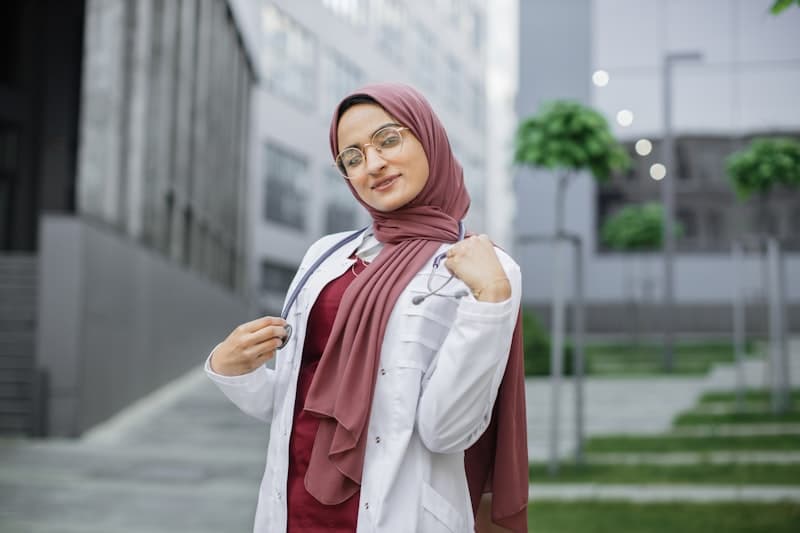
While the basic requirements are the same across specialties, the unwritten expectations vary by program type. Here is a brief guide:
- Surgical programs: Conservative is expected. Navy hijab, white coat, neutral background. Surgical residencies tend toward formality in everything, and your headshot should reflect that. Avoid anything that could be read as casual.
- Pediatrics and family medicine: Slightly warmer tones are welcome here. A friendly, approachable expression matters more than strict formality. Dusty rose or soft teal hijabs work well. The photo should convey warmth since that is what these programs value in their residents.
- Pathology and radiology: Standard professional headshot. These photos often appear in department directories and academic publications rather than patient-facing materials, so the emphasis is on looking polished and professional rather than approachable.
Regardless of specialty, the universal rule is that your headshot should look like you on your best professional day. Program directors will meet you at interviews. If your photo looks nothing like how you present in person, it creates an awkward first impression, even subconsciously.
FAQ
Can I wear my hijab in ERAS photos?
What background color should I use for ERAS?
Do I need a white coat in my headshot?
How recent does my photo need to be?
Are AI headshots acceptable for residency applications?
Medical-school-ready in minutes.
Professional headshots that preserve your hijab. 40+ styles, neutral backgrounds, starting at $19.